Saturday, November 14, 2009

Eurovision 2010....The Countdown Begins

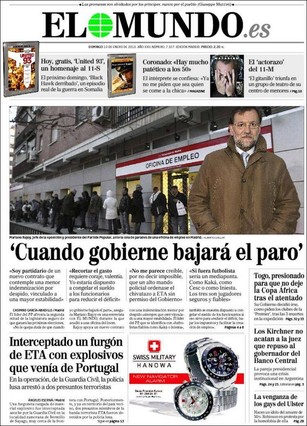
I know it's still early and that we haven't left 2009 yet, but I want to present a potential candidate for next year's Spanish Eurovision entry. I'm looking for suggestions for the name of the band, and for the song they can enter. Mamma Mia has already been taken, the Gürtel Blues might have pan-European possibilities. The choreography clearly needs a bit of work.

Friday, November 13, 2009

The Amazing Legend Of The Extremaduran Masturbation Workshops

As an example of how inaccurate news spreads rapidly across the Internet you could hardly do better than choose the reporting of a sexual education campaign launched by the youth department of the regional government in Extremadura. Because the name of the campaign is "El placer está en tus manos" and because masturbation is one of the many topics covered in the campaign it has now become more or less an established fact for many of those reporting on the issue that Extremadura is offering practical workshops on how to masturbate. This "bulo" started by some of the most notoriously inaccurate media in Spain has even spread to some of the foreign press.

The reality is very different and anyone who understands Spanish can read the document published by the campaign for themselves. This document seems to me to contain a sensible and straightforward exploration of many issues affecting sexuality. Naturally, those who believe above all else in the parental right to deprive their children of any sex education will no doubt be appalled by the content. The mere fact that it recognises the existence of homosexuality and contraception is in itself enough to enrage such people; hence the manipulation and distortion of its contents in some of the press.

One of the most bizarre aspects of the press coverage has been the emphasis placed on Extremadura being one of the poorest regions in the country. As if sex education should only be available for those areas with money to spend. The cost of the campaign is a hardly staggering €14000. Add up the cost to health and social services of unwanted pregnancies and sexually transmitted diseases and it won't take long to realise that this campaign will pay for itself even if only a tiny percentage of its target audience take it seriously. Obviously "Extremadura saves money through sensible sex education for young people" is unlikely to ever make it as a headline in the national or international press.

We'll probably now be hearing for years about the great legend of the Extremaduran masturbation workshops. It reminds me of the myths that still circulate in the UK about how the European Union is attempting to systematically extinguish all distinctive aspects of British culture. Many of them started life as tabloid inventions but they continue to live on for ever in the popular imagination.

Thursday, November 12, 2009

A Mexican Health Warning

The Mexicans are no fools when it comes to taking sensible health precautions. If you don't believe me take a close look at this poster advising citizens in the state of Hidalgo about how to avoid spreading swine flu.


Flu might be the least of your worries if you are trapped into a deadly embrace with one of these two shady characters. You are more likely to get a 20cm blade lodged in your rib cage when greeting Espe or Alberto.

Monday, November 09, 2009

La Coruña

Some photographs of an August weekend trip to the city I shall call, in the interests of linguistic diversity, (L)a Coruña. Amazingly, considering the amount of travelling I've done in the rest of the country, this was my first visit to Galicia since my first ever time in Spain - the same journey that took me to Navia. I guess this is because it is just not easy to do a short trip from Madrid to this region - unless you fly and you can get a good timetable. On that first visit to the country I ended my fairly random wandering in Coruña and to be honest the place didn't leave much of an impression. This time I was far more impressed, things have changed for the better and it is not a bad place to consider for a weekend trip. I even took the gamble of travelling without anything to protect me from the rain and it paid off. After a cloudy but dry Saturday, the following day saw Riazor beach packed with people for what seems to have been the first day of summer in the city this year, at least according to the taxi driver who told us it was the worst summer he could remember in 35 years.

Inside that stretch of the city bordered on one side by the beach and the other by the port there are some pedestrianised streets, one of which is full of bars and restaurants and which leads to the Plaza of Maria Pita, a heroine of the resistance against an unsuccessful English attack on the city in 1589. This isn't the only English connection to the city. Starting from the small old city a bit further down from Maria Pita, we soon arrived at the park where the remains of General Sir John Moore lie in a shady garden overlooking the port.


Wellington seemed to have a feel for the diversity in Spain with his message "Españoles, dedicaos todos a imitar a los inimitables Gallegos". A message which the web tells me has travelled as far as the Centro Gallego in Buenos Aires. Down below this memorial is the Castillo de San Antón and from there you can begin to walk the 10 kilometres of paseo maritimo that the city possesses. We walked it all, some bits more than once.


Overlooking the ria it was strange to find a muslim cemetery for the North African troops who fought with Franco's forces in the Civil War. Obviously had they fought on the other side then their bones would just have been tossed into a hole beside the road somewhere!. The cemetery itself has ceramic decoration from which you learn the Arabic origin of so many Spanish words.


The open land nearby was used as an execution site by the Civil War victors and a "stonehenge" style monument now marks the spot.


One thing you won't be able to ignore is the fact that there is a tower in Coruña. La Torre de Hercules, recently declared to be a World Heritage site, is the oldest active lighthouse in the world. Most of what remains of the original tower is still said to be of Roman origin, in spite of successive remodelling operations throughout the ages. You can ascend most of the way up the tower and the views are worth it provided you can put up with the wind. Before you see the tower itself you will see it engraved on the paving stones, on the city shield which appears everywhere, and on the numerous posters supporting the campaign for it to be listed by UNESCO.


Over on the other side of the beaches there is the hill of San Pedro. Like many hills overlooking Spanish cities this was under the control of the military until they finally surrendered it to the municipality in the 1990's. It is now a public park and provides excellent views over the city as well as in both directions along the coast. As a reminder of its past usage there are still bunkers and two enormous guns which were imported from Barrow in Furness at the beginning of the 1930's. These weapons were never used in anger but apparently their 35km range protected German boats that wanted to stop in the ports of Coruna or El Ferrol during the second world war. Isn't the arms trade a wonderful thing? The paseo maritimo continues some way past San Pedro and out of the city, and it's possible to do the ascent of the hill from the end of the paseo too. Alternatively, there is a strange space capsule funicular to save you the climb.


This trip was never just going to be about walking, and Operación Pulpo was declared to be a great success. We tried a couple of the pulperias, unpretentious places that specialise in the tentacled beast to the exclusion of almost everything else. One was not far from the Torre de Hercules itself, and the other was somewhere near the railway station, located in ugly new Coruña. Perhaps not surprisingly, what Madrileños know as Pulpo a la Gallega doesn't seem to exist under this name in the region itself. The pulpo is almost always served without the ever present potatoes you see in Madrid, unless you get some as a side dish. Although we lived mostly off octopus during the weekend we did manage to squeeze in a mariscada on the Saturday night. For lovers of seafood the mariscada is heaven, and there are people who like nothing more than setting to work with their nutcrackers to get a thin string of meat out of a crab's leg. Personally I'm not a big fan of meals where the energy expended in getting at the edible parts is greater than that gained from eating them. Apart from anything else, I just don't see the point of eating percebes (goose barnacles), which are rubbery, tasteless and hugely expensive. I concentrated mostly on the gambas and cigalas. Tough life, tough choices.

Monday, November 02, 2009

Ready For Rajoy's Super Tuesday?

Last year it always seemed to be Monday that was the worst day of the week for Mariano Rajoy, as it is for many of us. In Mariano's case it was because that was the day chosen by his enemies inside the Partido Popular to complicate his bid to stay as leader of the party. Well last week he must have felt that every day was Monday, so bad did things get that even Rajoy himself finally had to protest and...this was a novelty...take decisions!

It was bad enough with the bitter battle taking place within the PP in Madrid over control of Caja Madrid, a conflict that reached its peak with the (kamikaze?) interview that Manuel Cobo gave to El País, in which too much about Esperanza Aguirre's leadership style was revealed for anyone's liking. Then Valencia struck back in a bid to steal the limelight. Ricardo Costa had resigned as secretary general of the PP in that region as a result of the revelations from the Gürtel case, at least that was what the national party claimed. The problem was that he carried on doing the job and the press reported it. Even that might not have disturbed Rajoy's siesta if it hadn't been for the fact that Costa felt the need to draw attention to his defiance. At that point the national leadership finally decided they had to do something, and Costa was promptly suspended from the party.

Meanwhile Aguirre, despite having effectively lost the battle to place her man in charge of Caja Madrid, was still mobilising her forces and preparing to surround the Ayuntamiento of Madrid until she got someone's head on a spike. By now there was hardly a senior PP figure who wasn't out there somewhere with their diagnosis of what was wrong with the party. José Maria Aznar couldn't be left out and launched a thinly disguised attack on Rajoy's leadership. Proving just how little shame he has, he even called on politicians to act over corruption. Given that the guest list from his daughter's wedding now reads like a Who's Who of the Gürtel case you would think that a bit of discretion might be advisable.

We even got the opinions of Manuel Pizarro, who if you remember was the PP's economics superstar in the last election...for about 30 minutes. Pizarro treated us to a parable of a shepherd unable to lead his flock without the help of a trusty sheepdog to keep order. He finished by claiming that Rodrigo Rato would make an excellent president of Caja Madrid, and an excellent head of the government! Woken up just before the removal men arrived to carry him away, Rajoy invoked the spirit of Job and declared that his patience was at an end. What's more, he set a deadline to put an end to the PP's crisis and that deadline expires today.

It's been a busy weekend, Valencian leader Francisco Camps had what was said to have been a very tense conversation with Mariano about Costa, and today he finally announced a successor for Costa's job. Camps gives the impression of living in a parallel universe where everything is "muy bonito". Knives are being sharpened around him but he seems completely unaware of how his situation is deteriorating. In Madrid Espe sent out Ignacio Gonzalez to confirm her defeat, as Gonzalez gave way to Rato in Caja Madrid. Here is the man who is probably the big winner in all of this, not only does he get another nice little earner but he emerges untouched by all the infighting surrounding his appointment.

Today we will get Rajoy's speech to the national executive, now that he has ensured a temporary ceasefire. Stand by for the internal party code of conduct on corruption! This will presumably be followed by the family photograph where everyone will gather as near to each other as they can bear to stand, the weapons having been checked in at the door. On Wednesday we will find out whether Aguirre gets a consolation prize as Manuel Cobo appears before the PP's disciplinary committee charged with telling the truth. The PP has a lead of 3% over the government in the opinion poll published today, but with data gathered before the latest crisis; a lead that is due more to a decline in support for the PSOE than any significant rise for the PP. It will take a day or two before someone in the party unfavourably compares Rajoy's advantage with that enjoyed by the Tories in Britain, then they can all get back to fighting each other again.

Friday, October 30, 2009

Corruption Keeps The Judges Busy

It's disgraceful. Nothing more than a brutal persecution of some decent politicians by a politically motivated judge acting on the orders of the government. Who will put an end to this shameful witch hunt carried out by Baltasar Garzón against our democratically elected representatives? Oh sorry....it's not the PP involved in this one is it? That's ok then, justice must be allowed to take its course and the judges decisions must always be respected.

At least in Cataluña they can argue that they don't let ideology and petty party differences get in the way when it comes to municipal corruption. Those arrested a few days ago on Garzon's orders include prominent figures from the PSC, Catalan wing of the PSOE, and from the nationalists of Convergencia i Unio. Like many other corruption cases in Spain, the main source of income has been the commissions that get paid when almost worthless land suddenly, and mysteriously, gets reclassified as suitable for building. Following the logic of the early days of Gürtel there should now be demands that somebody not connected to the case resigns. How about Mariano Rajoy? That proposal would even attract support from within his own party.

The case in Cataluña comes hot on the heels of another one in the Almerian town of El Ejido. At the heart of that case is the mayor of the town, Juan Enciso, who had already earned himself a reputation as a nasty piece of work following the anti-immigrant riots there a few years ago. His attitude towards the immigrant labour force whose work made the town wealthy was summarised in a phrase along the lines of "there are never enough of them at 8 in the morning, and always too many by 8 in the evening". Not a person to shed any tears for, Enciso seems to have managed to turn El Ejido into his own personal property.

El País told us yesterday morning that there is "desolación" in the Spanish parliament in the face of the growing number of corruption cases coming to the surface following the property boom. Clearly this feeling is still not so strong that either of the two major parties feel the need to legislate against corruption. In fact I suspect they will probably feel better after a good lunch or two and their sense of desolación certainly wasn't enough to stop them from voting down a motion that would oblige them to declare their assets. It's hard not to avoid the impression that what really causes the most pain is that there are some judges prepared to investigate these cases.

Wednesday, October 28, 2009

As Soitu.es Closes, Which Way To The Future?

Yesterday saw the sad announcement that Soitu.es, an independent Spanish web based news platform, was closing down after only 22 months of existence. Soitu was seen as an innovative development representing for many the future shape of information delivery on the internet. It established a sizeable readership in its brief existence, and went for an approach based around participation and sharing of technology and resources. The widgets I have used on this blog to report election results, and the software for the charts I have occasionally published all came via this site.

The problem was that Soitu was launched just a short time before the economic crisis started to bite. A site that delivered its content free of charge depended on income from advertising, and it is the collapse in such income that has provoked closures and sackings across the Spanish media in the last couple of years. There is currently no shortage of creative talent in the industry, but the model which allows that talent to be able to work on a sustainable basis doesn't seem to have been found yet. In hard times like the present, the publicity dependent business needs a friendly sugar daddy to keep it going. Soitu just had a bank, the BBVA, and it seems that they have now pulled the plug. Ironically, the same bank continues to advertise on the site with banners asking "¿Cuando quieres pagar? Tu decides".

With casino capitalism still being allowed to run rampant, we live in an age of constant economic instability and any business based on assumptions of good times can now find itself itself in trouble every 5 or 6 years as we lurch from bubble to bubble. The optimistic view would say that failures like that of Soitu are a necessary part of the process of establishing the future structure of information delivery. The problem is that current trends in the industry are in many ways leading to the sacrifice of quality in exchange for immediacy and volume of content. Legions of copy and paste merchants at work mean that it's possible for a story to appear in one site, and then echo around the others in no time - much of what passes as "news" being generated by trawling through what others have already published.

The widespread assumption is that media groups will need to start charging for content, but breaking the everything is free on internet habit is going to be even more difficult if the quality of the product being offered isn't worth the money. It's worth placing bets on who will be the first major media group in Spain to make a renewed push for a subscription based service for internet news delivery. Newspaper sales continue to decline in Spain almost wiithout exception, and all of the major media groups are having to rethink their business.

For some the solution is to widen the potential audience, and for Spanish media groups that means looking towards the American market. El Mundo, whose printed edition is now also called El Mundo.es, has opened an American section on its web site with news from the different countries. Whether this news is just rehashed coverage from the different media in South America is hard to tell. Meanwhile the owners of El País, Grupo Prisa, already have substantial business interests in South America and have now started investing in Hispanic media in the US as well. Expanding the target audience may help, but we will have to wait and see whether it's enough to make the difference.


Monday, October 26, 2009

Notorious Bandit Cornered In Caja Madrid

Full credit to Esperanza Aguirre, she never allows anything else to take priority over her own ambitions. When it comes to defusing a crisis you would never pick up the phone and dial E for Espe. Take the (still) ongoing battle for control of Caja Madrid, the regional savings bank and fourth largest financial institution in Spain. What began as just another example of Espe's empire building, handily combined with having a swipe at her rival Alberto Ruiz Gallardón, has now been transformed into a full scale confrontation between Aguirre and the Partido Popular national leadership. We're almost back where we were in the aftermath of the PP's general election defeat last year.

Having got her way in changing the law concerning representation in the governing body of the Caja, Aguirre has moved to propose one of her closest political allies - Ignacio Gonzalez - as the president of the bank. This has provoked a reaction from the PP's leadership who finally appear to have had enough of Aguirre's stealthy accumulation of power. PP leader Mariano Rajoy has made it clear that he thinks the job should go to former finance minister and IMF director general Rodrigo Rato. This is quite a shrewd move on the part of Rajoy, it's very hard for Espe to openly reject Rato as a candidate, he was the powerful figure in the Madrid PP before she took over and is widely respected within the party. There are suggestions that he is not really Rajoy's preferred candidate as the two men were rivals to succeed Aznar and are not said to get on well. Despite this, Rajoy is said to be determined to stop Gonzalez getting the job, amongst other reasons because the latter strongly criticised Rajoy's leadership when Aguirre was toying with the idea of becoming Mariano's successor.

So now it's a question of who will blink first, for the moment both sides are steadily maintaining the tension as the rest of the PP watches in bewilderment and dismay; as if Gürtel wasn't enough! Aguirre can impose her will, if she decides to gamble on Rajoy backing down. She has the power to push through whatever she wants in Caja Madrid. However, it's a high stakes gamble and the PP is not a federal party where each region can do what it likes. Ultimately, Rajoy has the power to remove Aguirre from her own position, although it's very unlikely he would choose to take things that far. He's not a person who has a reputation for standing firm, as we've seen with the farcical case of Ricardo Costa in Valencia who may or may not have resigned, depending on who you choose to believe.

The government has let it be known that they don't want Rato in Caja Madrid, officially because he walked out on the IMF to pursue the scent of money in investment banking, but probably more because he is too much of a heavyweight political figure for their liking. The Madrid section of the PSOE has been brought into line, a few days ago they seemed quite happy with the plans of La Lideresa as they had been promised some important posts of their own in return for supporting Gonzalez. The government candidate is a lesser known PP figure, Luis de Guindos, whose banking experience consists of having been boss of the Spanish division of, gulp, Lehman Brothers. Very confidence inspiring.

All sides loudly proclaim their intention of "depoliticising" the selection process, whilst at the same time pushing the politician of their choice. Not that too much attention should be paid to those who demand a more professional profile for the job. This is coded language for a banker. You know, one of these people who takes your money, multiplies it by a hundred, takes a good percentage of that as a reward for their efforts, gambles the rest on a dodgy package of someone else's bad debts, then tells you to ask the government for your money back. Frankly I think I prefer the politician, or at least one who would have the objective of making Caja Madrid serve the region. Gonzalez is obviously not that person, but the Spanish economy could use banks that do better things than just borrow cheap money from the European Central Bank to lend it back at a profit to their own governments.

Anyway, you shouldn't take any notice of what I write about Aguirre and her way of operating. It's much better to read direct testimony from within the Madrid PP, the priceless interview with Manuel Cobo published in this morning's El País. Cobo is particularly good on a favourite theme of mine, the difference between Aguirre's words and her actions. Manuel Cobo is the main political ally of Gallardón and this won him the distinction of being a prime target for Espe's gang of spies. He's clearly been waiting an opportunity like this to hit back and surely had the approval of Gallardón for what he has done. The reaction of Aguirre's supporters to the Cobo interview is, true to form, to threaten him with disciplinary measures. It all helps to demonstrate the sad fact that the most effective opposition to Espe in Madrid currently comes from within her own party.

Saturday, October 24, 2009

Las Tablas De Daimiel On Fire

A few months ago I wrote a post on the plight of Las Tablas de Daimiel, but it seems that since then the situation in what is supposed to be one of the most important wetland areas of Spain has got even worse. The lack of water in the park has now led to a situation where underground peat fires are burning, and the European Union has threatened to intervene to force the Spanish government to act.

There's nothing very natural about this disaster, and it looks as if the Spanish government has more or less decided to let the park die. Now, with the threat of outside intervention, there is talk of a water transfer being arranged from the Tajo River. The poor Tajo seems to be the solution to everyone's water problems, and already there have been complaints from Murcia that water should be used to help preserve a national park when they can be using it to grow tomatoes. Precisely the attitude that has led to the once water sufficient Tablas reaching the state they are in today. It would be interesting to know whether any water from the Tajo still makes it across the frontier into Portugal. If anyone ever wants to create a monument to unsustainable management of water resources then Las Tablas de Daimiel will be as good a place as any.

Thursday, October 22, 2009

The Gürtel Case Casts A Long Shadow

One of my unfinished posts before going on holiday was going to argue that the impact of the Gürtel corruption case was only just beginning to be felt. The main reason was not so much the continuing revelations in the press about the activities of Francisco Correa and company, it was more because the case was still under the "secreto del sumario", which keeps the investigation confidential until the prosecution case is established. While I was away that protection was partially lifted and those who liked to believe that the whole case was just an anti Partido Popular operation invented by Baltasar Garzón now have 17,000 pages of evidence to read involving criminal accusations against over 70 people. That should keep them going until the other two thirds of the case is also revealed. It is said that the main reason for the continuing secrecy is that investigators are following the international trail of the Gürtel millions.

Meanwhile the main action in the last month has been in Valencia. A police report claiming that the Valencian PP was using illegal funding from companies that received contracts from the regional government ended up causing far more damage than the case of Mr Camps and his very fine suits. After a protracted tussle, the national PP leadership eventually managed to force the resignation of Valencian PP general secretary Ricardo Costa. The nature of that battle tells us much about Mariano Rajoy's "leadership" of his party. Ever since being reelected as leader of the PP, Rajoy has spent much of his time in Valencia as regional president Francisco Camps had effectively become his main prop within the party. For Rajoy to make the Valencian party bend to his will in the case of Costa was never going to be easy and at one point it looked quite possible that he would fail. In any case, the temporary "resignation" of Costa appears to be a fiction; although not appearing publicly in the name of the PP it seems that he is still working from his office in the party headquarters.

Camps himself is seriously damaged by the affair, and there has been plenty of speculation about him being finished politically - some of it coming from within the PP itself. The arrogance shown by the Valencian PP in shrugging off evidence of corrupt behaviour doesn't just come from Rajoy depending on their support. The clear unwillingness of the Valencian courts to deal with any evidence against Camps and his allies must be very reassuring, as is the evidence of opinion polls that most PP voters in the region couldn't care less about the corruption of their representatives. The Valencian judges put on a magnificent display of judicial cynicism over the police report, which they had received from Madrid. We'll deal with that after the case of the suits, they said. Then, having shelved the case against Camps over his presents from the Gürtel ring, they used the fact that there was no case open any more as an excuse for not dealing with the police report! Such loyalty will surely bring rewards.

Back with the main prosecution case, we have learnt from the published evidence in a case already overrun with nicknames that Correa liked to be called "Don Vito". Clearly this was a man who did his utmost to avoid attracting any suspicion within the PP about his activities. Correa's own declarations also reveal that the advancement of his influence in the PP was much helped by Madrid's deputy mayor Ana Botella taking a shine to Álvaro "El Bigotes" Pérez. She likes men with moustaches, and the presence of both Correa and Pérez at the wedding of Aznar and Botella's daughter is the simple answer to those who would pretend that these people were marginal figures in the PP. Right on cue we get the announcement this week that Aznar - stop giggling at the back, this is serious - is going to deliver a series of classes on ethics and politics at a Catholic university in Murcia. I swear on a copy of today's Marca that I'm not making this up. Despite all of this the PP still seeks to present itself as a helpless victim of Correa and friends on the one hand ("los chorizos"), and the implacable persecution orchestrated by a shady organisation known as "el gobierno" on the other. If it doesn't bring a tear to your eye then you have no heart.

Saving the best for last, let's turn to Madrid and our revered regional president. Fans of Esperanza Aguirre, and she has some, have praised her for a quick witted reaction to the lifting of the secreto del sumario. She immediately expelled the three members of her group in the regional parliament who are facing criminal accusations, and her behaviour has been contrasted with that of the slow response by Rajoy and the Valencians. What is far more interesting is what the Gürtel sumario tells us about the way Aguirre's government works. She likes to present herself as showing the way when it comes to austerity and lean government, but almost all of the numerous and expensive contracts awarded by Espe's administration to the Gürtel companies concerned the organisation of events designed to promote the image of Aguirre herself.

Some examples. Espe visits an industrial estate in Getafe? Ka ching! That will be over €30,000 into the Gürtel coffers. La Lideresa inaugurates a school, an event you might have thought would cost little more than the price of her Metro ticket. Ka ching! More thousands of euros for Gürtel. Nothing is sacred here, how about a homage to the emergency workers that dealt with the aftermath of the Madrid bombings? Ka ching ka ching! Those who do not understand the dynamic of the liberalisation of public services may fail to comprehend why Madrid had to repeatedly pay the Gürtel companies to hire the same four plasma screens, or the red carpet tiles, or some of the most expensive flowers ever bought. As true economic liberals, Madrid's rulers handed the companies concerned over 300 contracts, broken into smaller ones where necessary to avoid any need to put the contract out to tender. We wouldn't want the chill winds of competition to spoil such a nice little earner. Despite this and the fact that she has had months to examine all the contracts, Aguirre would like us to believe she didn't know what was happening.


Wednesday, October 21, 2009

Marching Against Abortion, But Only When The Left Are In Power

As my post on the Gürtel case is still very much a work in progress let's turn our attention to last weekend's demonstration against the Spanish government's proposed abortion law reform. It's extremely bad manners to organise such a major demonstration of Madrid's permanently angry right when I'm still on holiday but we'll let that pass. Were you there? If we believe the reports in the right wing press, it would be easy to get the impression that almost the whole Spanish population turned out for the event. A tidal wave of decent Spaniards marching united against Zapatero the baby killer.

Well not quite. Despite the now habitual claims by the organisers, the sympathetic press and the Comunidad de Madrid of a million or two attending, it seems that the true number fell well short of 100,000. Apart from those who habitually attend these events to estimate numbers, there is a new kid on the block. A company called Lynce claims that it has software which can count the number of people occupying a given space from aerial photos. Such a method would obviously be open to question in a genuine march which starts at one point and ends at another as you have to take into account the movement of the participants. Fortunately, that's not the case for the demonstrations organised by the Partido Popular and allies; they are generally static affairs concentrating crowds in a prominent Madrid street for the benefit of the Telemadrid helicopter. The PP doesn't walk.

Since we're on the subject of Telemadrid it's worth noting that the channel did its very best to encourage participation in the demonstration, virtually the only thing lacking was a direct instruction from the Lideresa herself for viewers to desert their sofas and take to the streets.


Santa Esperanza was of course there, and was joined by Jaime Mayor Oreja and none other than the Moustachioed Crusader, Jose Maria Aznar. The latter was accorded superstar treatment by many of the nostalgics who so fondly remember his time in office. Oddly, for a demonstration against abortion, none of them appeared to remember that during Aznar's time in office it's estimated that approximately 500,000 abortions took place in Spain. We can't be on the streets all the time was the excuse offered for this memory lapse by one of the organisers, who appeared to have forgotten that he occupied a position in the same government. PP leader Mariano Rajoy simply forgot to go, although he claims that he didn't want to politicise the event! The PP has now said it will introduce it's own reform when it returns to office, although the party refuses to spell out even a single detail of what that reform will involve. The signs from the turnout, habitual exaggerations apart, are that abortion doesn't even get the full PP hardcore support onto the streets, never mind the less rabid voters they need to attract if they are to stand a chance of winning an election.

If we needed a reminder of why the abortion reform is necessary it came a few days ago. In my first post on this subject I mentioned the case of a fishing exercise carried out by members of the Guardia Civil eager to find evidence of illegal activity at a Madrid abortion clinic called Isadora. This included doorstepping women who had been to the clinic and subsequently the judicial decision to allow an extremist anti-abortion organisation to involve itself in the case. The case has finally been stopped, because not a single indication of illegal activity had been found. Despite the absolute lack of evidence, a handful of police officers and a sympathetic judge have been allowed to intimidate women who had taken the (never easy) decision to have an abortion under the existing legislation.

Tuesday, October 20, 2009

Duntrekkin

I'm back from my walk. I got back yesterday morning but the effects of a 24 hour journey from Kathmandu to Madrid via Delhi and London meant that I haven't been able to do very much since. That Delhi stopover almost cost us our holiday as over zealous British Airways employees demanded to see a visa for India in both Madrid and London on our way out. It took the intervention of supervisors in both cases to let us board the plane. I understand that airlines have effectively been converted into border control organisations, but in our case there was absolutely no reason to stop us from flying. In Delhi we simply went to the transfer lounge and waited until someone brought us our boarding passes for our onward connection, along with lots of other people in the same situation. I wonder how many people with poor English are denied the right to board their flight in London because of badly trained BA staff telling them they can't fly? The holiday itself was a fantastic experience, better than I expected and I will have plenty to write about it in the coming weeks. In the meantime I've got some catching up to do, I was right when I assumed that interesting things would happen in my absence.


Saturday, September 26, 2009

Taking A Break, But Not Resting

This blog has been fairly quiet recently and I have all sorts of half-completed posts which haven't quite made it as far as publication. Things are about to get worse, because of this. I'm not sure whether it's a good idea but it certainly promises to be an experience. Frankly, I'm hoping that the description of it being a "tea-house trek" turns out to be true, that sounds like my level. In the event that I survive the trip I should be back at full blogging rhythm sometime around October 21st. Naturally, because I'm going away, lots of things will happen in the meantime concerning the topics I most like to blog about.

Friday, September 18, 2009

Taking The US For A Ride With Spain's Renewable Energy

Some time ago, when the Obama administration in the US expressed interest in the extent to which Spain was developing renewable energy sources, the opposition to such developments siezed on a report that had been published by a leading member of the Instituto Juan de Mariana. The report by Gabriel Calzada claimed that the investment in clean energy in Spain was destroying many more jobs than it created. This was of course good news for the Republicans, the fossil fuels industry and right wing media outlets such as Fox News - so the Calzada report got far more than its Warholian 15 minutes of fame. Even more absurdly, Calzada was happy in his interviews to back the idea that Spain's current unemployment problems were a result of this investment in clean energy.

However, now there is a reply to Calzada's claims and it demonstrates fairly neatly the line that divides genuine academic research from industry funded propaganda. The response from the National Renewable Energy Laboratory highlights multiple defects in the original report, both in the methodology used and in the conclusions. Calzada's case rests fundamentally on the claim that if all the money spent on subsidising clean energy had been spent on private sector job creation then the result for employment would have been much better. Of course there is no reason at all to assume that this is what would have happened.

The original report doesn't even take on board the simple truth that not every job costs the same, as if training a doctor is equivalent to putting someone to work in Burger King. No mention at all was made of the benefits from exporting the technology and expertise, already significantly more than the subsidy received, and other incidental factors such as a reduced dependence on imported energy also fail to feature in Calzada's analysis. The methodology is, of course, the opposite to that used in scientific research. First you define the conclusions that you want to arrive at and then you set about carefully selecting and manipulating your evidence to try and fit those conclusions.

The Insitituto Juan de Mariana is one of the homes of Spain's busy little group of neoconservatives. Having arrived so late for the original game it seems that they are now determined to "out-neocon" everyone else in a bid to make up for lost time. Renewable energy is precisely one of those areas where Spain can become a leader and develop much needed alternatives to construction and tourism. As Spanish companies try to sell their expertise in renewables overseas it can't be very comforting for them to know that the these people are out there doing their very best to undermine those efforts.

Wednesday, September 16, 2009

Go On, Insult Your Boss

It's ok, if your boss is giving you a hard time you are allowed to call him a "hijo de puta" and not be sacked for it; or at least to claim your compensation. Quite right too, they can sit around the lunch table using the same words to describe their employees and nothing ever happens.

Tuesday, September 15, 2009

The Next Train May Not Stop In Lisbon

Spain has become an issue in the Portuguese general election campaign following the pledge by the right wing candidate to stop the planned high speed rail links between Lisbon and Spain's expanding AVE network. The idea is that high speed train lines should enter Portugal both from Badajoz and Vigo. The Portuguese right were in power when the plan was initially approved but now seem to have decided to stir up a bit of anti-Spanish sentiment in the campaign by presenting the train plan as a Spanish imposition. Maybe they are obeying the saying that only bad winds and bad marriages come from Spain, or perhaps they are just keen to show that Spain doesn't have an Iberian monopoly on crazed nationalist right wingers. In reality the plan would plug Portugal into the emerging European high speed network rather than place them under Spanish domination. The first time I ever travelled to Portugal I went by train from London to Oporto and the journey took me around 36 hours. There are some who don't like to travel so slowly, although perhaps they should try it sometime.

Not everyone in Portugal thinks the same about their neighbours. A poll that was reported on a few weeks ago showed that 39% of the Portuguese would be prepared to consider a union with Spain. Whilst quite a few Spanish tend to smugly assume that this means the Portuguese just want to join Spain, the reality is probably that those in favour would prefer some sort of federation rather than just adding 5 or 6 new autonomous comunidades to those that already exist. There is a widespread feeling in Portugal that the country somehow missed the boat and lost out on many of the benefits of EU membership compared to Spain. Then there has been the unequal economic performance with Spanish companies dominating sectors of the Portuguese market, although that gap may well be closing now that Spain has become the land of the bankrupt builder. Leaving to one side some of the incidental details, such as 39% not normally being regarded as a majority, it's worth thinking about what shape such a union might take. Portugal is a republic, something that is to its credit. How would the Portuguese take to coming under a Spanish king - again? In any case, according to my 21st Century calculations monarchy + republic = republic. Then imagine how Madrid's loony right would react to Lisbon's children being educated in, gasp, Portuguese! If such a project ever took off it would probably be the spur to Spain finally becoming a federal state. Anyone for the Federal Republic of Iberia?

Monday, September 14, 2009

Does The Road To Catalan Independence Pass Through Arenys?

There are potentially a number of ways of encouraging public support for independence in Cataluña, but in the case of the vote held this weekend in the municipality of Arenys de Munt it seems that they found the perfect combination. 96% of those voting supported the idea, and whilst the turnout was not huge it still exceeded that for other more official popular consultations. True opinion on the issue in Cataluña as a whole is hard to measure because it always depends how the question is presented, but the most recent figure I saw put it at 19%.

Part of the credit for the pro-independence vote has to go to the Spanish state prosecution service who decided to take the issue to court because the municipality was proposing to provide facilities for the vote; even though it wasn't organising it. The courts duly ruled that such an issue went beyond the powers of the local ayuntamiento, which may be true but it's hard to avoid the suspicion that they may not have been so quick to act had the question put to the vote been "Shall we all club together and buy a new yacht for the King to use on his holidays next summer?"

If the action of the abogados del estado wasn't enough to mobilise the voters, how about the prospect of having the fascist Falange marching through the middle of your town? Apparently one of the reasons why Espanyol football club requested Real Madrid not to hand out tickets for Saturday's game to their Ultras was so that Arenys would not be graced with their presence on the following day. That might have pushed the pro-independence vote up a couple of points more. In the end a meagre 50 fascists made it to the town, only to be heavily outnumbered by journalists, police and pro-independence demonstrators.

A vote in a small municipality of 8000 people has attracted huge media attention and looks like sparking a competitive battle between Catalan nationalist parties keen to ride the wave as long as it goes in their preferred direction. Esquerra Republicana clearly sense an opportunity to reverse their electoral decline in recent years, although there are also signs of a new pro-independence alternative emerging in the shape of a breakaway grouping from that party. All it needs now for the movement to take off is for the Spanish Constitutional Court to strike down a couple of key clauses in the Catalan autonomy statute. The rumours that they will do this have been strong in recent weeks, and the delay in their verdict is becoming almost unsustainable.

Thursday, September 10, 2009

The Pijo Rebellion

In the reporting of the disturbances the other day in the Madrid dormitory town of Pozuelo, much has been made of the fact that the town is one of the wealthiest in the region. Despite the predictable plea of the town's administration that those who fought with police were "outsiders", the finest brains of the nation have since tried to make sense of the events that would cause the gilded youth of Pozuelo to attack a police station. Perhaps it's the economic crisis? But when the banks have guaranteed profits no matter what happens to everyone else, and the stock market rises ever higher on the back of the grimmest crisis in decades, then it seems unlikely that a decline in the fortunes of Papi's SICAV is causing Pozuelo's youth to take to the streets.

The "Defensor del Pueblo" thinks the parents are to blame, which is a harsh accusation to make against the people who appointed him to his comfortable post. The man who presents Telemadrid's Soviet style news programmes says that it's all the fault of television! When all else fails there's always the botellón, symbol of the decline of civic values in whatever remains of Ejpaña. Things start to look dangerously counter-revolutionary when we find out that members of the aristocracy were involved. I've always felt they were a bunch of troublemakers, but we'll have no truck with calls for the return of the guillotine on this blog. Still, you would think his parents might have warned him about the dangers of pouring too much Vega Sicilia into the kalimotxo.

Sunday, September 06, 2009

Navia

Many years ago, way back in another century, the Lone Guiri stepped off the FEVE train in the small Asturian town of Navia. Making his way into town he found a room in what was then almost the only hotel there was. First stop was the local tourist office, a fairly limited affair in those far off days. The man in the office wasn't really expecting any guiris although he didn't actually say "We don't see many strangers around these parts". We chatted for a while in pidgin French, the only language in which we could understand each other. It emerged that Navia, like most of the region in mid-August, was in fiestas. Later on that day I met him again in the street and he introduced me to his friend the English teacher at the local school, which helped communication no end. The Lone Guiri then became the Adopted Guiri and spent a very enjoyable weekend in Navia with these two and their group of friends.

It's not a very pretty place to look at. I know because I've just been there again a couple of weeks ago.


Your memory plays tricks with you after so many years because the place I remembered seemed to have been much smaller. Perhaps I didn't get the real measure of the town because it was in fiestas and I had a fairly thorough introduction to the concept of the cubata and the art of staying up very late. One place I do remember well is this beach and the trees that lie just a short distance behind it. It was in this place that we ate a huge paella cooked over a wood fire (probably illegal to do this now) and washed down with several bottles of Asturian cider.


The area between the town and the sea is still very nice and unspoilt, and a walkway has been constructed beside the river for pedestrian access to the beach. There is also now a longer coastal route which can be walked, something to bear in mind for my next visit.

I hadn't even planned to come to Spain on that holiday, but the weather over the French Pyrenees convinced me to try my luck further south. I crossed the frontier with no guide book and about 5 words of the language. My first ever taste of Spain was San Sebastian, followed by Santander and Oviedo. Then I decided to try something that wasn't one of the bigger towns and the random biro point made a hole in the map just beside Navia. I enjoyed the other places I visited - particularly San Sebastian. However, as I drifted off into a paella and cider induced siesta by Navia beach I'm pretty sure that it was here where I first thought something along the lines of "You know, I think I could come back to this country".


Friday, September 04, 2009

The Age Of Consent

The Partido Popular has little time for thinking these days, dedicated as it is almost full time to the defence of the corrupt. It's not really what they do best anyway. So when the PP does take on other issues it soon becomes clear that they haven't really thought them through. This week we have had almost simultaneous proposals from the party that would reduce the age of penal responsibility to 12 whilst at the same time restricting access of the under 18's to social networking applications such as Facebook. The PP veers between a concept of purity and childhood innocence in some cases and regarding all children as potential monsters in others. On the one hand much of their opposition to the proposed abortion law reform is based around the suggestion that 16 year olds will be able to obtain an abortion without the consent of their parents. For the PP these are mere "chicas" who are clearly unable to make up their own minds on the issue of whether they want to be a parent or not. On the other hand the 13 year old who commits a crime is an evil monster who must be locked away for the good of society. I suppose it has the compensatory side effect that whilst you are serving time in one of the PP's youth prisons at least you will never have to receive the dreaded email message "Mariano Rajoy Added You As A Friend On Facebook".

Thursday, September 03, 2009

Madrid's Fading Olympic Flame

Madrid's attempt to host the 2016 Olympic Games has taken a serious knock following the issuing of the reports on the candidate cities yesterday. It looks like their Powerpoint skills may have let them down, or perhaps lunch wasn't to the liking of the visiting delegation? In any case the city is trailing behind rivals such as Rio de Janeiro or Tokyo. Personally I'm delighted at the news, there may be cases where hosting the Games brings a real boost to a city but that is only the situation where those in charge have the imagination and skill to use the event to make a difference. Madrid's administration fails on both counts, the bid being much more about the attempt by mayor Alberto Ruiz Gallardón to promote himself and his political career at vast expense for an already heavily indebted city. Two strikes and you're out, Madrid already lost the last time around.

The City of Eternal Trenches has been a sight for sore eyes this summer as Plan E has come to the rescue of the Pharaoh´s broken budget. I have read reports that those taking the open topped tourist buses that drive around the city centre have seen little else except workmen drilling holes in the asphalt. The smart Olympic betting says that Rio will get much of the Latin American support and that some European countries will not support the Spanish bid because they intend to be contenders for the following games. Then there is the question of whether Obama throws his weight behind Chicago. Given that the final selection might well be based on what we should call "other criteria", there could still be hope for Gallardón. He doesn't have much else to look forward to at the moment, having had to resign himself to being the PP candidate for mayor yet again in 2011. His waiting game continues, but life is much less fun with no money to spend.

Wednesday, September 02, 2009

Pagar Impuestos Es De Pobres

As all the talk circulates of the need for tax increases to pay for the consequences of the economic crisis, it's clearly time to put in a word for the less fortunate amongst us. Let me introduce you to the SICAV, an investment vehicle for what is usually described as the "grandes fortunas" in Spain. Anyone can start one of these very special companies, provided you have 2.4 million euros at hand. Such is the unbearable fiscal pressure on those who have sacrificed their lives and health to raise the money for a SICAV, that when the annual tax bill comes in they are required to pay a distressing 1% tax on the profits of their investments. This is compared to 25% or more for a normal company, without even talking of the standard rates of income tax. Whilst there will always a resentful few who will suggest that those who did so well out of the bubble economy could perhaps contribute something to the cost of paying for its downfall, it seems unlikely that Spain's government will be presenting them with the bill. There are far more pressing reforms needed whilst we still have some people working who enjoy employment protection. El Roto in El País put it very well this morning.


Thursday, August 20, 2009

A Poor Way To Help The Needy

You have to wonder at times whether the Spanish government has anyone on call to warn them about potential political disasters. Maybe they all go on holiday in August? The announcement was made the other day that the unemployed who have exhausted their eligibility to receive unemployment benefit would receive a replacement payment of €420 a month. It's not a lot of money, but compared to having nothing at all it starts to look better. Not surprisingly, with many households in Spain where no member of the family currently works there were queues forming quickly at the unemployment offices. Then it emerged that the new payment is only available to those who have exhausted their right to benefit after the 1st August. Leaving aside for the moment the evident unfairness of such an arbitrary limit, the simple fact that this wasn't made clear at the time of the announcement has just meant that an issue intended to demonstrate concern for those with no resources to maintain themselves has backfired in the most spectacular way. Is there really nobody at all around the government who saw that one coming?

Tuesday, August 18, 2009

Water Not Holy Enough For Swine Flu

The Spanish Catholic Church has shown a disappointing lack of faith in its own propaganda recently. The faithful who came to Toledo last weekend to pay homage to La Virgen del Sagrario were advised not to follow the traditional customs of kissing the Virgin's medal or drinking the "agua de la Virgen" from communal containers. Why the Virgin should have a medal is a mystery to me, presumably it's awarded for good behaviour. Anyway, the reason for the advice was the risk of passing on swine flu. This is more than a little ironic when you consider that the water from the holy well has long been claimed to have curative powers! Meanwhile, poor Madrid bumps along in mid-table in the international swine flu league with a miserable 700 cases a week. Although we're still in the pretemporada.

Sunday, August 16, 2009

Millonarios En Tiempos De Crisis

It's tough out there on the street. Some people think it's all about shopping, but then a journalist comes in and asks you about the crisis! What's that all about, can't you see I'm busy?


Saturday, August 15, 2009

Rompiendo El Silencio

There is a very valuable NGO working in Israel called Breaking The Silence. This group is made up of soldiers who have taken part in Israeli army operations in the occupied territories of Palestine, and is therefore in a privileged position to report on the routine abuses committed as part of that occupation. So how does the Israeli government respond to the revelations of such a group? The choice is between acting against the perpetrators of such barbaric activities, or acting against those who reveal their existence. It will come as little surprise to find out that it is the latter policy that has been adopted. The Spanish government provides a small contribution of around €60-70,000 a year from international cooperation funds to help fund the work of the group, and the Israeli government has decided that the best way to suppress any criticism of their activities is to put pressure on those who fund Breaking The Silence

Thursday, August 13, 2009

Another Fine Trick With The Euribor

The Euribor, that artificial interest rate which has been used so successfully to produce windfall profits at the expense of Spanish mortgage payers, has slowly come down to a level which almost approximates to the real interest rate. All of this should be of enormous benefit to those who have been struggling to keep up with massive mortgage payments as a result of having to buy during the property bubble. This will not be the case for many thanks to the ingenuity of the banks. Many mortgage holders find that their bank has set a minimum level of interest on their mortgage which currently means that they can be paying more than double the figure of the Euribor. The banks protest at criticism, saying that they also set a maximum level. However, that maximum will only be ever hit if we get a rate of price increases that sets us on a path towards hyperinflation. Spain isn't quite there yet, with 5 consecutive months of "official" deflation.

Meanwhile, our good friend Gerardo "Aguirre es cojonuda" Díaz Ferrán has got yet another suggestion for getting him out of the crisis at the expense of everyone else. Wages should be cut so that those whose mortgage payments have fallen feel no benefit. Careful, we're not talking about everybody's wages and especially not about Gerardo's pay packet. Spain's top executives have continued to increase their salaries even in the midst of the crisis. I welcome this news, mostly because it means we can now treat those who claim that such lavish rewards are in some way "performance related" in the same way as we would regard members of any crazy religious sect.

Wednesday, August 12, 2009

Cycling Across Mallorca

So where were we? Oh yes, the Palma Arena. Mallorca's government decided a few years ago that what the island really needed was an international class indoor cycling arena - a "velódromo" for those as keen as I am to add to their Spanish vocabulary. Originally the Arena was budgeted to cost a little over 40 milllion euros. That seems quite a lot for a cycling arena, but it turns out that the final cost has been more like 110 million. No explanation can be found for the increase and no documentation appears to exist showing where the money went. All of this led to the arrest last week of several prominent members of the Partido Popular in Mallorca. The suspicion is of serious embezzlement coupled with the added possibility of illegal funding of the PP. It is the latest of a whole series of cases in the last few years involving the local administration headed by former Aznar minister Jaume Matas, who had the good sense to head off to the US as soon as he lost power in the last elections.

All sorts of events are held at the Palma Arena. Except cycling competitions. Despite the 70 million euro overspend it seems that the track was built with cheap wood and doesn't come up to international standards. Never mind, there's always the concerts. Those accused of dodgy dealings concerning the velódromo have been busily engaged in another popular Spanish sport known as "echando balones fuera", and they claim the overspend was necessary to correct the original project - designed by the same man who managed to provide Beijing with a perfectly usable Olympic cycling arena. The arrests more or less coincided with the miraculous saving of the honourable Mr Camps and the subsequent announcement that the prosecutors would appeal that decision.

This rollercoaster of events has sent the PP into hysterical overdrive with the accusation that the government is orchestrating a vicious campaign against the party. Much has been made by the PP of their members being taken before the judge in handcuffs. Here they are being treated as if they were criminals when all they are in reality is, er, suspected criminals. There are people who have been treated much worse for stealing a loaf of bread, but then they don't hold party membership cards. It has taken Mariano Rajoy with his keen sense of historical significance to introduce the Spanish Inquisition into the story. Rajoy, like other members of the PP leadership, has been issuing his declarations from his August holiday destination. Presumably the Inquisition have brought out that most lethal of all weapons, the comfy deckchair!

Leading the charge from the PP chiringuito has been the inevitable Federico Trillo, who claims to have definitive proof of illegal espionage against his party. Trillo's case is not standing up well to examination. His evidence consists of an alleged tape of a police officer informing Camps of the transfer of the case against him to the Valencia courts. The tape, if it really exists, is hardly evidence of espionage. Trillo also claims that a report accusing him of telephoning one of the judges involved in the Camps case is further proof of the spying. It is claimed that he was in fact talking to a PP lawyer with the same surname as the judge. Something doesn't fit here, if he was really being spied upon then presumably the original report would have got its facts right.

If anyone didn't understand at the time why Aznar's last government was so keen to disable the anti corruption prosecutors they had hailed when in opposition, there can be little doubt about it now. The roots of much of what is emerging lie in the "we are the masters now" arrogance of that government. Trillo and other PP leaders are seeking to create a political climate which pardons corruption, based on the sad fact that their supporters seem willing to continue voting for them regardless, and this odd insistence that for every PP member accused of corruption at least one prominent member of the PSOE should resign. This has to be the most comfortable group of "persecuted" people outside of the international banking system. Whether the profits of their work lie inside or outside of that same system has yet to be established. The investigation continues.

Sunday, August 09, 2009

Heidelberg

I'm a bit busy chewing on octopus tentacles in Galicia this weekend, so all you'll get out of this blog is some pictures of a weekend trip to the German town of Heidelberg in June. From a previous day visit a few years ago I had the idea of Heidelberg as being completely swamped by tourists, and it has to be one of the biggest tourist destinations in the country. Despite that, once the lunchtime marabunta passes the place is not so busy and in the evening it is relatively quiet in the old town. We had some fantastic weather the weekend we were there which means you also appreciate the surroundings a bit more. The town has plenty of restaurants for all tastes and mostly reasonably priced. Hotels are significantly more expensive than in other parts of Germany although if you search on Internet you can get something for a reasonable price a bit out of season.


Heidelberg castle is the main destination of most of the tourist groups which sweep through the town. For that reason, it's best to get up there quite early shortly after it opens. The castle is, to use the words of an English estate agent, in need of some repair. But then that's part of its attraction.


Continuing up the hill behind the castle you reach the Königstuhl. There are footpaths to take you there although the lazy can use the funicular railway. The whole area is a natural park with numerous walking and cycling trails through the woods, but being a civilised country there is also a beer garden near to the top of the funicular. Down by the river when we were there it seemed that half of the town was taking advantage of the great weather and gathered on the grassy banks by the Neckar. There were wedding parties, barbecues or just groups of friends taking it easy with a beer - there don't seem to be any anti-botellon laws in Germany or any need for them.


On day two we headed over to the other side of the river and took what they call the "Philosophers Way" up the hillside. As with the area behind the castle this leads up to the woods, again with dozens of marked trails. So what did the Nazis do for Heidelberg? Well they built the Thingsstatte ampitheatre up on this hill for their "special events". A bit further up beyond this is a much older ruined church, from where you get a good view of your surroundings.


Friday, August 07, 2009

So Who Spies On The Spies?

In the aftermath of the case of Mr Camps and his very fine suits, the Partido Popular has again opted for the politics of distraction. They are now claiming that the whole party is being subjected to illegal interception of communications, even affecting those few sections of the PP leadership stil left untouched by the multiple corruption scandals their representatives are involved in. The latest case in Mallorca leaves us with very few members of the former PP administration on that island who haven't yet been charged with corruption. Nevertheless, the obvious question that occurs to me about such allegations is how the PP leadership could possibly be sure that any espionage taking place doesn't come from within their own party?

Remember the Madrid espionage scandal? Well it hasn't gone away and despite the obligatory August break for exhausted judges, the case is continuing to advance. Mobile telephone records have blown apart the attempt by the Madrid PP to claim that the agents employed by Esperanza Aguirre's administration were not engaged in tracking the activities of former Aguirre loyalist Alfredo Prada after he opted to support Mariano Rajoy. It's now clear that Prada was followed by some former Guardia Civil officers who had been personally recruited by the regional secretary general of the PP, Francisco Granados. The latter of course shares his political position with that of being in charge of "justice" in the regional government, a situation which you're entitled to regard as coincidental if you want to. The main point is that it allows the agents to draw a salary as public servants instead of having their espionage expenses paid for by the PP.

Th evidence of the phone records was of course flatly denied at the time of the fraudulent commission of investigation into the affair. Granados and the Comunidad have now changed their argument to claim that the spies were engaging in tasks of ensuring the security of Prada - even though Prada himself has no knowledge of this and the Comunidad de Madrid does not possess any power to carry out this kind of task. It's a role still belonging to the national police. Apart from anything else, such security activities always have to be communicated to someone who has his own security escorts, otherwise you end up with shooting in the street. Someone has not told the truth and interestingly enough those who mislead parliamentary commissions are also committing an offence. Could be a busy autumn for the judges.

The similar case affecting Manuel Cobo, a key political ally of Alberto Ruiz Gallardón, is going to be more difficult to establish because the stored mobile phone records do not go back as far as the dates when he was said to have been followed. Clearly the pretext of security vigilance would be even more difficult to use in Cobo's case as he is not even a part of the regional government. Despite this, I think we have some credible suspects. María Dolores, they're behind you!